“Getting to the ideal customer is getting harder and harder” is a common frustration I encounter every week in conversation with sales leaders across industries. Markets are noisier, buyer behaviours are shifting, and the tools we use to identify opportunities are smarter—but also more complex.
Yet when I dig deeper and ask these leaders a simple question—“Who is your ideal customer?”—they often struggle to answer. Not vaguely. Not in broad strokes like “tech companies” or “anyone who needs what we sell.” I mean a real, grounded, evidence-based Ideal Customer Profile (ICP). Because without one, even the best sales strategy is just educated guesswork.
In this week’s Sales Wellness Weekly, I’ll unpack what an ICP really is, why it matters, where many go wrong, and how to build a practical and actionable one that empowers your sales team to work smarter—not harder.
What Is an Ideal Customer Profile?
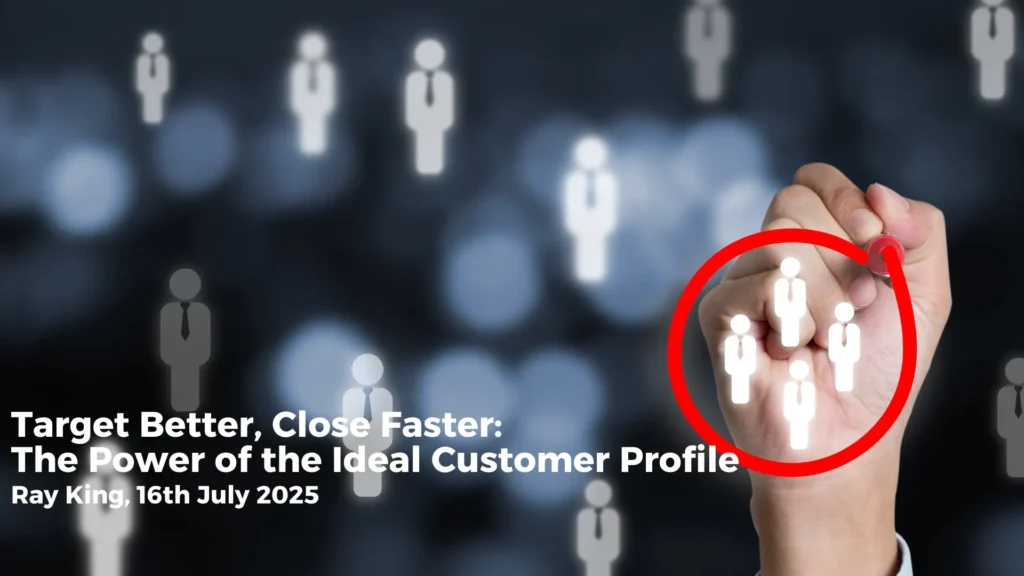
Your Ideal Customer Profile is a detailed description of the company (or companies) that derive the greatest value from what you offer—and in turn, deliver the greatest value back to your business.
It’s not a wish list. It’s not your biggest deal ever. It’s not just “who we like working with.” A true ICP is grounded in data, experience, and measurable characteristics such as:
- Industry or vertical
- Company size
- Annual revenue
- Tech stack
- Budget ranges
- Buying process
- Growth stage
- Common pain points
- Fit with your product’s strengths
- Lifetime value or average deal size
- Sales cycle length
- Churn likelihood
An ICP isn’t a buyer persona (although they complement each other). An ICP focuses on the type of organisation you want to target. Personas, on the other hand, describe the individual decision-makers within that organisation.
Why a Clear ICP Is Critical for Sales Success
Having a clearly defined ICP does three important things for a sales organisation. Without these, teams default to guessing, chasing volume instead of value, and wasting resources on leads that were never a good fit in the first place. Here’s what a clearly articulated ICP can do for your team:
It focuses your time and energy where it matters most.
Your sales team operates within strict limits: limited hours, limited attention, limited energy. Yet sales environments are louder than ever—more leads, more tools, more meetings, more admin. In this chaos, an ICP acts like a filter, separating the signal from the noise.
When your team knows exactly who to go after, they can prioritise with confidence. That means less time wasted on dead-end prospects, and more time engaging with organisations that are genuinely a good fit. The result? Shorter sales cycles, higher win rates, and fewer burned-out reps.
Imagine the difference between fishing in the ocean with a net and fishing in a stocked pond with a spear. That’s the power of focus.
It strengthens alignment across your go-to-market (GTM) teams.
Misalignment between Sales and Marketing is one of the most common—and costly—problems in B2B growth. Sales complains that marketing leads are unqualified. Marketing says sales isn’t following up fast enough. Round and round it goes.
Often, this conflict traces back to a basic disconnect: they’re targeting different types of customers.
For example, Sales may believe their best-fit client is a UK-based B2B SaaS firm with 20–200 employees and a specific tech stack. But if Marketing is running campaigns aimed at US-based HR tech enterprises, the leads won’t convert—and everyone gets frustrated.
A shared ICP eliminates this disconnect. It creates a single version of the truth about who the business is trying to reach, ensuring that everyone—from SDRs to CMOs to product marketers—is rowing in the same direction. The result is not just better leads, but a more cohesive strategy and culture.
It supercharges your messaging, targeting, and overall performance.
Think about the last outreach email you received that actually caught your attention. Odds are, it spoke directly to your role, your challenges, or your business goals. That kind of resonance doesn’t happen by accident—it’s the result of a team that knows exactly who they’re speaking to.
When your ICP is dialled in, your messaging becomes far more effective. You can tailor your value propositions to your target customer’s specific needs, pain points, and aspirations. You know which objections are likely to come up—and how to counter them. You can design campaigns, content, demos, and discovery calls that land.
In a market where attention is scarce and trust is earned slowly, relevance is a superpower.
Not only that, but a strong ICP improves performance across the board: prospecting conversion rates go up, qualification becomes more consistent, demo-to-close ratios improve, and lifetime value increases—because you’re selling to people who are more likely to get long-term value from your product or service.
The ICP Trap: Why It’s Not a Silver Bullet
Let’s be clear—defining your Ideal Customer Profile is one of the most important things you can do to focus your sales efforts and drive better outcomes. But some sales leaders fall into the trap of thinking it’s a one-and-done solution. That once you’ve written down your ICP on a slide or tucked it away in your CRM, the hard part is over.
Unfortunately, that’s not how it works.
An ICP is a strategic tool—but it’s not a miracle cure. It won’t fix poor sales hygiene, low pipeline velocity, or misaligned messaging on its own. And like any strategy, its effectiveness depends on how it’s applied, reviewed, and evolved over time.
Here’s where many teams go wrong:
It’s a moving target.
What made a company “ideal” for you two years ago might not be true today. Maybe your product has matured and serves larger organisations now. Maybe your pricing model changed and small clients are no longer profitable. Or perhaps the market itself has shifted—competitors have emerged, budgets have tightened, or buying committees have grown more complex.
If your ICP doesn’t keep up with these changes, you risk anchoring your entire GTM motion to outdated assumptions. You may find yourself chasing prospects who used to be a good fit, while ignoring those who are the best opportunity today.
ICP development isn’t static. It should be reviewed regularly—ideally every quarter—and adjusted based on real performance data and frontline feedback.
It can create blind spots.
A clearly defined ICP helps create focus—but too much focus can become a liability.
When your ICP is treated as a strict filter rather than a directional guide, your team may end up overlooking promising outliers. Think about that unusual inbound lead that doesn’t tick every box but turns into a long-term, high-value customer. Or the new vertical that’s starting to show interest in your solution but hasn’t been formally added to your ICP yet.
Rigid ICPs can also bias your team toward legacy customer types or personas, even if those segments are in decline or increasingly difficult to win. If your ICP becomes a “box-checking” exercise rather than a thinking tool, you’ll miss opportunities hiding in plain sight.
The key is to balance consistency with curiosity—train your reps to use the ICP as a guide, not gospel.
It requires continual refinement.
The ICP isn’t a “set it and forget it” asset—it’s a living, evolving part of your GTM strategy.
Your product changes. Your value proposition sharpens. Your pricing adjusts. Your best customers today might look different from those of last year—and your worst customers probably do, too.
A static ICP risks locking your organisation into a fixed mindset. It must be continuously informed by:
- Win/loss data
- Churn analysis
- Customer success feedback
- Market intelligence
- Frontline sales input
- Product development roadmap
The best sales organisations treat the ICP as a collaborative asset, not a marketing document. It’s regularly revisited in quarterly GTM reviews, stress-tested in pipeline reviews, and updated when new customer patterns emerge.
It’s a tool for guiding decision-making, not replacing it. The most successful sales leaders know when to follow it rigorously, and when to break the mould.
Building Your Ideal Customer Profile (The Right Way)
Here’s a framework for developing an ICP that actually helps your team sell better:
Step 1: Look Back Before You Look Forward
Start with data. Analyse your past deals. Who churned? Who expanded? Who referred you? Look for patterns in company size, industry, geography, and deal characteristics.
Step 2: Talk to Customer-Facing Teams
Sales reps, customer success managers, onboarding leads, they all have stories about dream clients and red-flag accounts. Capture their insights and frustrations. Anecdotes matter just as much as analytics.
Step 3: Score and Segment
Create a basic scoring model. Assign values to different characteristics. For example, maybe SaaS companies score high, but only if they have less than 200 staff and use HubSpot. This process helps you prioritise effectively.
Step 4: Align Internally
Sales, marketing, product, and leadership need to agree on the ICP. Otherwise, you’ll chase different goals. Document it, share it, and revisit it quarterly.
Step 5: Operationalise It
This is where most ICPs die. They live in document or slide deck, never to be seen again. Instead, bake it into your CRM. Train reps to qualify leads against it. Use it to filter inbound leads. Bring it up in every pipeline review.
Conclusion: The Cure for Sales Waste
If your team is constantly chasing leads that ghost, or you find yourself closing clients that churn fast, the problem may not be your pitch, your pricing, or your people.
It may be that you’re chasing the wrong customers.
Your Ideal Customer Profile is the foundation of strategic sales success. Not a vanity exercise, but a way to ensure that every outbound sequence, ad campaign, SDR call, and demo request brings you closer to the customers who matter most.
You’ll still need skill, hustle, and discipline. But with a clear ICP, at least you’ll be running in the right direction.
If you’d like a no-obligation conversation about how to define or refine your Ideal Customer Profile, I’d be happy to offer a free 30-minute consultation. No sales pitch — just practical insight based on what’s working for other sales leaders. Drop me a message and we’ll set it up.
The Sales Doctor
Consult | Assess | Recommend | Execute
Post by Ray King, 16th July 2025