Handling price objections is too many a real challenge. Few moments can test a sales professional’s confidence quite like hearing the words: “You’re too expensive.”
It’s the phrase that can make even seasoned salespeople hesitate, question themselves, or start mentally discounting before the buyer’s even finished talking. But for sales leaders, this moment represents something more profound. It is not just a pricing objection, but a test of the team’s clarity, confidence, and understanding of value.
When your team encounters price pushback, they’re not facing a financial objection, they’re facing a value perception problem.And how they handle that moment says everything about the culture, coaching, and confidence you’ve built as their leader.
Let’s explore why price objections often have less to do with cost and more to do with communication, and more importantly, how to turn those moments into opportunities for stronger value conversations.
Price Pushback Is a Symptom, Not the Cause
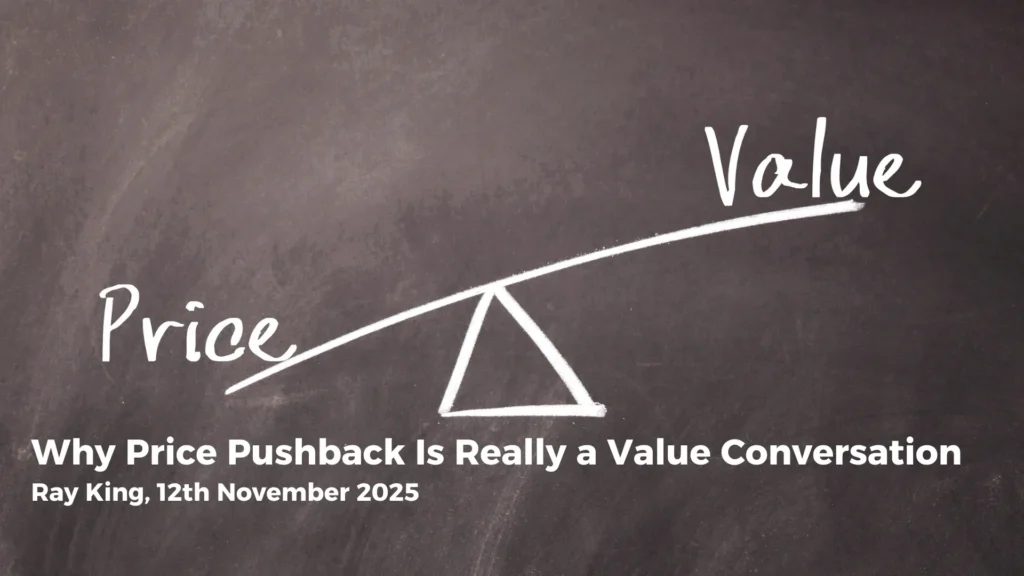
When buyers push back on price, they’re not always saying “I can’t afford it.” More often, they’re saying “I don’t yet see why it’s worth it.” That distinction changes everything.
Too many salespeople treat price as the final battleground of a deal; the moment where negotiation begins and value defence ends. But in reality, the price conversation is just the mirror reflecting the quality of the conversation that came before it.
If a buyer doesn’t see clear differentiation, if they can’t articulate the impact, or if they feel uncertain about outcomes, they’ll always default to price. Because when value is vague, price becomes the only thing that feels concrete.
For sales leaders, that’s a coaching signal. It’s not just about teaching objection handling. It’s about rewinding the tape and asking: Where did value clarity break down?
- Was the discovery too shallow?
- Was the business pain quantified?
- Did the salesperson connect the dots between problem, impact, and outcome — or just talk features and benefits?
Price pushback is rarely a negotiation failure. It’s usually a positioning failureearlier in the process.
Value Is Felt Before It’s Calculated
Buyers don’t buy based on logic alone. They justify with logic but decide with emotion, and that’s why price conversations are emotional moments. The buyer might feel exposed, cautious, or under pressure, or they may fear making a costly mistake or being judged internally for overspending.
So when a salesperson hears “too expensive,” it’s not just about numbers — it’s about trust.
If a buyer trusts that you understand their world, their pressure, and their priorities, they’ll look for ways to make the budget work. If not, they’ll look for ways to cut it. As a leader, your role is to coach emotional intelligence as much as commercial skill. Your team needs to understand that value isn’t a statement, it’s a feeling.
Value is built when the buyer senses that your solution truly fits, that it will deliver measurable impact, and that the salesperson cares about the outcome beyond the transaction. That’s why great salespeople make buyers feel understood long before they ask them to invest. The moment a buyer feels value, price becomes a discussion — not a defence.
The Art of Staying in Control Without Being Controlling
Price pushback often triggers a reactive instinct: defend, justify, explain. But true control in sales isn’t about talking more, it’s about asking better questions.
When a buyer challenges price, a confident salesperson doesn’t scramble to justify it. They slow down. They get curious. They ask:
- “Can I ask what you’re comparing us to?”
- “What outcome or result would make this feel like great value to you?”
- “If budget wasn’t a factor, is this the right solution for you?”
Each question reframes the conversation. Instead of defending numbers, the salesperson explores perception. Instead of reacting, they reassert calm control.
As a leader, this is where your coaching makes the difference. Train your team to see objections not as barriers, but as windows into how the buyer is thinking. The goal isn’t to “win” the argument, it’s to realign perspectives.
Great sellers don’t pressure buyers into seeing value. They guide them there, and that’s the skill your team needs to master: controlling the tone of the conversation, not the direction of the buyer’s decision.
Confidence Is Contagious — and So Is Insecurity
Discounting doesn’t just damage margins. It damages confidence. Every time a salesperson folds on price too quickly, they’re teaching the buyer that the value was negotiable, and teaching themselves that it probably wasn’t worth defending. That’s why your role as a sales leader isn’t just to enforce pricing discipline, it’s to build belief.
If your team isn’t convinced of your solution’s worth, no script will save them. Confidence doesn’t come from memorising rebuttals; it comes from internal conviction. Make sure your team can clearly articulate:
- The problem you solve
- The cost of inaction
- The measurable impact your solution delivers
When those three are clear, price becomes proportionate, not personal. Confidence creates composure. Composure creates control. And control allows your team to navigate even the toughest pushback without panic.
Build a Culture of Value Defence, Not Price Erosion
Handling price objections well shouldn’t rely on a few confident individuals. It should be cultural. In top-performing sales teams, value isn’t something that’s “sold” — it’s something that’s lived and reinforced. That means:
- Marketing messages that align with sales language.
- Case studies that quantify outcomes, not just praise service.
- Leadership narratives that celebrate deals won on value, not price.
If you only celebrate wins, you teach short-termism. If you celebrate howthose wins were achieved, especially when sellers held their ground, you reinforce the long-term strength of your value story.
As a leader, you set the tone. Every message you share, every debrief you run, every metric you track, it all signals what “good” looks like.
If your team believes that holding the line on value is respected, not risky, they’ll start doing it more naturally.
Conclusion
When buyers say “too expensive,” they’re not rejecting your price, they’re revealing what they don’t yet understand about your value.
The difference between discounting and defending lies in how your team hears that phrase. Is it a threat to close the deal, or an opportunity to deepen the conversation? As a sales leader, you’re not just managing numbers; you’re shaping narratives about worth, confidence, and clarity.
Coach your team to slow down, listen deeper, and reframe the moment. Because every “too expensive” is really an invitation: Show me why it’s worth it.
When your team can answer that, they’ll not only win more deals — they’ll win them on their own terms.
Would you like help coaching your team to handle price objections with confidence — without discounting?
I’m offering a free 30-minute consultation. No pressure, no pitch — just practical ideas to help your team defend value, ask smarter questions, and turn price pushback into productive, trust-building conversations.
The Sales Doctor
Consult | Assess | Recommend | Execute
Post by Ray King, 12th November 2025